
Understanding and Calculating Your Pool Pace
Why knowing your pool pace matters in open water swimming

Swimmers new to open water are often new to pool workouts as well. To train effectively, you need to understand the basic “language” of the pool and, more importantly, your pool pace.
Pool Pace vs. Open Water Pace
Many people inquiring about an Alcatraz or marathon swim give us a pace off of their smartwatch from the open water. And while this is data, it’s unreliable because it doesn’t tell the entire story. Open water times can be heavily influenced by tides, currents, weather and other factors.
A pool pace is a controlled and measurable environment allowing one swimmer to be compared to another swimmer regardless of date or location.
As a swim organizer, it allows us to group or “pod” people of similar paces for planning a swim and safety.
Pool Basics: Yards vs. Meters
In the US, most recreational and competitive pools are either 25 yards (Short Course) or 50 meters (Olympic Long Course).
When you see a workout that asks for a “100,” the number of lengths is different:
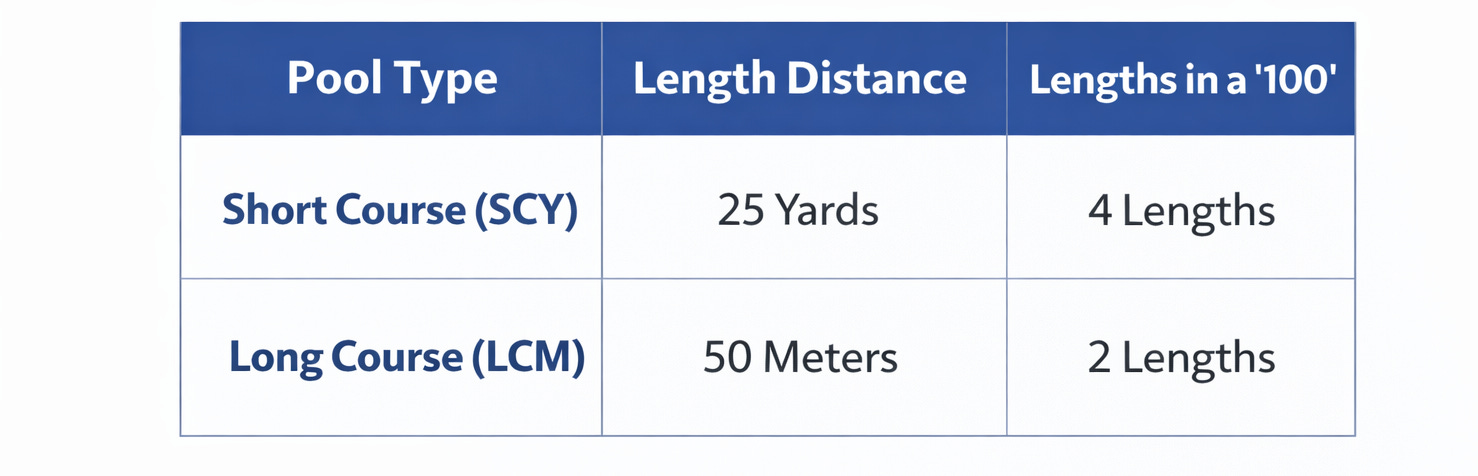
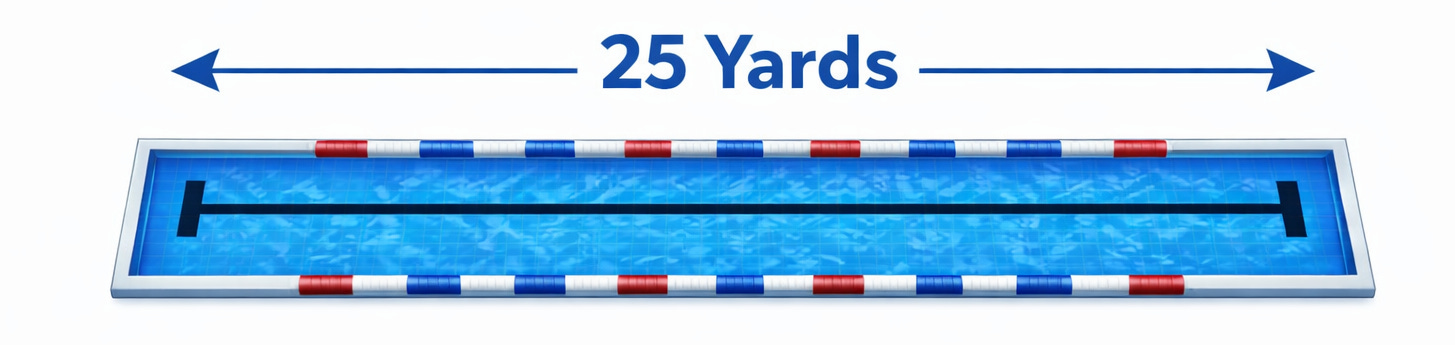
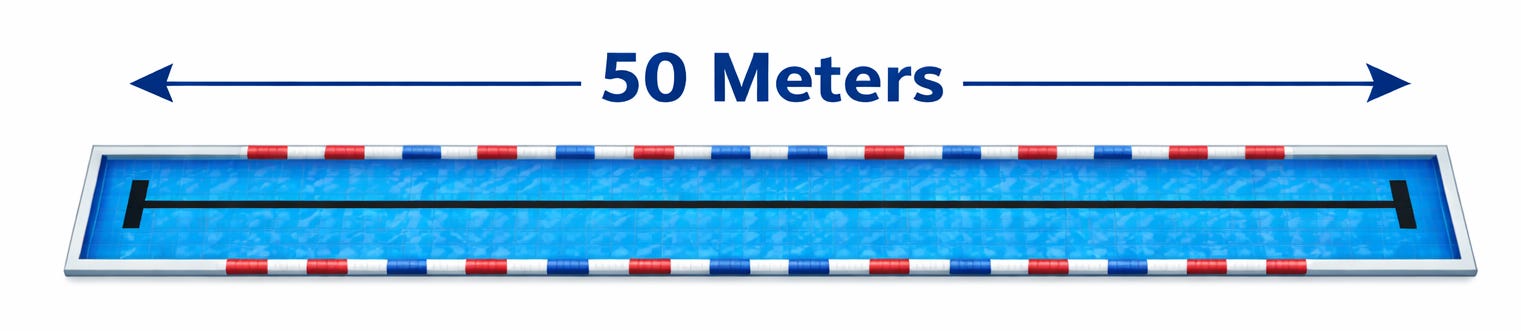
Note: 100 meters is roughly 110 yards. If you are training in meters, you are swimming about 10% further than you would in a yard pool.
Lap or Length?
A length is from one end of the pool to the other. A lap means down and back (two lengths). However, many people will use length and lap interchangeably in a casual setting.
For coaching and getting times, a length is a length and a lap is down and back.
Length = One way
Lap = Down and back
Getting Your Pool Pace
Pace is not your fastest 100 yard (or meter) time, but your average time when swimming a comfortable, non-stop 500 or 1,000 yard (or meter) freestyle in the pool. Easy flip turns or open turns are fine. The key is to swim freestyle non-stop to understand your ability to maintain pace over longer distances.
Note: When we ask for pace, a swimmer can provide a 100 time in either yards or meters and we convert it all to yards for our planning purposes.
Or use our Swim Pace Calculator to convert it.
25 Yard Pool: 500 yard and 1,000 yard times
500 yards = 20 Lengths
1,000 yards = 40 Lengths
Use the pool clock or the stopwatch function to get the total time it takes to swim 500 yards (20 Lengths) or 1,000 yards (40 Lengths).
Take your total time and input it into our Swim Pace Calculator to get your 100-yard time. Or you can do the math yourself and divide by 5 for 500 yards or 10 for 1,000 yards to get your average 100-yard time.
Example:
Swimmer A: 500 yards in 09:25 = 1:53/100 yards
Swimmer B: 1,000 yards in 21:00 = 2:06/100 yards
Now let’s take the same swimmers and put them in a 50 meter long course pool.
50 Meter Pool: 500 meter and 1,000 meter times
500 meters = 10 Lengths
1,000 meters = 20 Lengths
Use the pool clock or the stopwatch function to get the total time it takes to swim 500 meters (10 Lengths) or 1,000 meters (20 Lengths).
Take your total time and input it into our Swim Pace Calculator to get your 1-00-meter time. Or you can do the math yourself and divide by 5 for 500 meters or 10 for 1,000 meters to get your average 100-meter time. Our swim pace calculator will automatically show your meter and equivalent yard time!
Example:
Swimmer A: 500 meters in 10:18 = 2:04/100 meters
Swimmer B: 1,000 meters in 22:58 = 2:18/100 meters
Results:
Swimmer A has a 1:53/100 yard pace or 2:04/100 meter pace
Swimmer B has a 2:06/100 yard pace or 2:18/100 meter pace
Short Course vs. Long Course Times
Yes, for the diehard competitive pool swimmers, there is a difference in short course vs. long course times. Short course times are generally faster due to the ability to shave time off with efficient underwater streamlining and extra turns with wall push offs. For the purposes of this article, the goal is to simply help swimmers calculate their 100 pace in the pool.